
Volume 15, Issue 3 (10-2025)
J Health Saf Work 2025, 15(3): 501-531 |
Back to browse issues page



Download citation:
BibTeX | RIS | EndNote | Medlars | ProCite | Reference Manager | RefWorks
Send citation to:


BibTeX | RIS | EndNote | Medlars | ProCite | Reference Manager | RefWorks
Send citation to:
Kolahdouzi M, Najafian Y, Karimi A. Evaluating the Effectiveness of Pressure Sensors in Mitigating the Risk of Ammonia Cargo Release in Transit: A QRA-Based Case Study in a Petrochemical Transport Company. J Health Saf Work 2025; 15 (3) :501-531
URL: http://jhsw.tums.ac.ir/article-1-7204-en.html
URL: http://jhsw.tums.ac.ir/article-1-7204-en.html


1- Department of Occupational Health Engineering, School of Health, Tehran University of Medical Sciences, Tehran, Iran
2- Department of Occupational Health Engineering, School of Health, Tehran University of Medical Sciences, Tehran, Iran ,a_karimi@sina.tums.ac.ir
2- Department of Occupational Health Engineering, School of Health, Tehran University of Medical Sciences, Tehran, Iran ,
Abstract: (2022 Views)
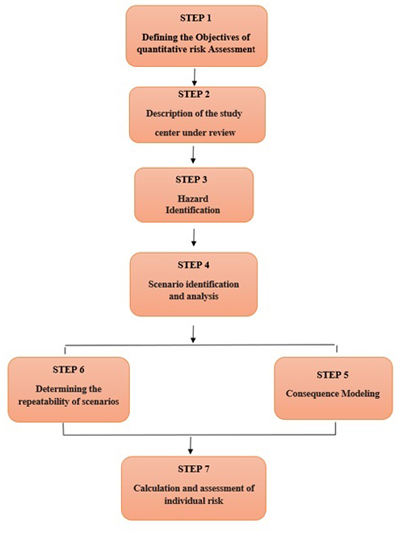
Introduction: Transporting hazardous materials is inherently associated with multiple risks that can threaten human health, the environment, property and infrastructure. The deployment and operation of ammonia tanks in various industrial projects and organizations with diverse objectives present serious safety, health and environmental challenges. Therefore, conducting risk assessment in the chemical sector is essential. This study aimed to evaluate the effectiveness of a pressure sensor in reducing the risk of ammonia cargo release during road transportation, based on Quantitative Risk Assessment (QRA) in a petrochemical transport company.
Material and Methods: This study assessed the risk of ammonia release from a pressurized tanker and investigated the risk-reducing effects of employing a pressure sensor for leak prediction. Consequence modeling and QRA were conducted using SAFETI version 9.
Results: The results showed that the installation of a pressure sensor on the ammonia tanker reduced the gas release duration from 40 to 25 minutes, which consequently decreased the volume of the leaked gas and ultimately reduced the overall risk level of accidents. This risk reduction varied between 55% and 99% under different atmospheric conditions. By decreasing the release time from 40 to 25 minutes, the lethal radius of ammonia was consistently reduced in all weather conditions. The analysis of individual risk contours in the sudden rupture scenario revealed that atmospheric conditions, particularly during winter nights, had the greatest impact on the expansion of lethal zones.
Conclusion: The use of pressure sensors and alert systems can effectively reduce individual risk level. Continuous monitoring of tank conditions and prompt alerts in the event of leaks or pressure drops enable faster response and help prevent escalation of accident consequences.
Material and Methods: This study assessed the risk of ammonia release from a pressurized tanker and investigated the risk-reducing effects of employing a pressure sensor for leak prediction. Consequence modeling and QRA were conducted using SAFETI version 9.
Results: The results showed that the installation of a pressure sensor on the ammonia tanker reduced the gas release duration from 40 to 25 minutes, which consequently decreased the volume of the leaked gas and ultimately reduced the overall risk level of accidents. This risk reduction varied between 55% and 99% under different atmospheric conditions. By decreasing the release time from 40 to 25 minutes, the lethal radius of ammonia was consistently reduced in all weather conditions. The analysis of individual risk contours in the sudden rupture scenario revealed that atmospheric conditions, particularly during winter nights, had the greatest impact on the expansion of lethal zones.
Conclusion: The use of pressure sensors and alert systems can effectively reduce individual risk level. Continuous monitoring of tank conditions and prompt alerts in the event of leaks or pressure drops enable faster response and help prevent escalation of accident consequences.
Type of Study: Research |
Send email to the article author
| Rights and permissions | |
 |
This work is licensed under a Creative Commons Attribution-NonCommercial 4.0 International License. |