

Volume 15, Issue 4 (12-2025)
J Health Saf Work 2025, 15(4): 761-779 |
Back to browse issues page



Download citation:
BibTeX | RIS | EndNote | Medlars | ProCite | Reference Manager | RefWorks
Send citation to:


BibTeX | RIS | EndNote | Medlars | ProCite | Reference Manager | RefWorks
Send citation to:
Afshari M J, Alimohammadi I. Experimental Validation of a Numerical Model for Predicting the Thermal Performance of a Liquid Cooling Garment. J Health Saf Work 2025; 15 (4) :761-779
URL: http://jhsw.tums.ac.ir/article-1-7255-en.html
URL: http://jhsw.tums.ac.ir/article-1-7255-en.html


1- Occupational Health Research Center, Department of Occupational Health, School of Public Health, Iran University of Medical Sciences, Tehran, Iran
2- Occupational Health Research Center, Department of Occupational Health, School of Public Health, Iran University of Medical Sciences, Tehran, Iran ,irajrastin1@gmail.com
2- Occupational Health Research Center, Department of Occupational Health, School of Public Health, Iran University of Medical Sciences, Tehran, Iran ,
Abstract: (648 Views)
Introduction: Computer-based numerical simulation can serve as an effective approach for replicating system behavior over time. It enables the analysis of a system’s capabilities, capacities, and performance during the design phase—prior to physical implementation. Accordingly, simulation tools can be used for the design, modeling, evaluation, and visualization of heat transfer interactions among the components of a Liquid Cooling Garment (LCG) system. Therefore, the present study was conducted with the aim of designing and experimentally validating a numerical simulation model for a thermoelectric-based LCG.
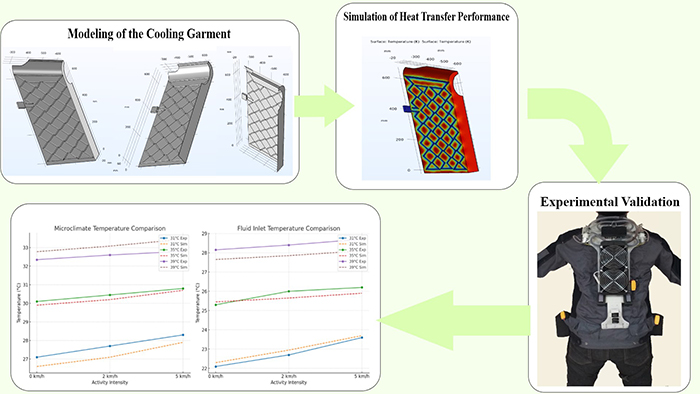
Material and Methods: A new model of a liquid cooling garment (LCG) based on fluid circulation was developed using the Finite Element Method (FEM) in COMSOL Multiphysics software. To validate the simulated model, a physical prototype of the LCG with similar characteristics was designed, and human experiments were conducted under controlled environmental conditions. Finally, the findings obtained from the simulation and experimental results were compared.
Results: The results showed that the difference in microclimate temperature between the simulated predictions and the average experimental data ranged from 0.1 °C to 0.65 °C. Additionally, the deviation in coolant temperature within the piping system between the simulation and experimental data ranged from 0.1 to 0.6 °C. These findings indicate that the developed model demonstrates a satisfactory level of accuracy in predicting thermal parameters
Conclusion: The results suggest that the proposed model can serve as an effective tool in the design and evaluation process of wearable cooling systems before fabricating physical prototypes. Further studies are recommended to enhance the performance and precision of LCG simulation models.
Material and Methods: A new model of a liquid cooling garment (LCG) based on fluid circulation was developed using the Finite Element Method (FEM) in COMSOL Multiphysics software. To validate the simulated model, a physical prototype of the LCG with similar characteristics was designed, and human experiments were conducted under controlled environmental conditions. Finally, the findings obtained from the simulation and experimental results were compared.
Results: The results showed that the difference in microclimate temperature between the simulated predictions and the average experimental data ranged from 0.1 °C to 0.65 °C. Additionally, the deviation in coolant temperature within the piping system between the simulation and experimental data ranged from 0.1 to 0.6 °C. These findings indicate that the developed model demonstrates a satisfactory level of accuracy in predicting thermal parameters
Conclusion: The results suggest that the proposed model can serve as an effective tool in the design and evaluation process of wearable cooling systems before fabricating physical prototypes. Further studies are recommended to enhance the performance and precision of LCG simulation models.
Type of Study: Research |
Send email to the article author
| Rights and permissions | |
 |
This work is licensed under a Creative Commons Attribution-NonCommercial 4.0 International License. |