

Volume 15, Issue 4 (12-2025)
J Health Saf Work 2025, 15(4): 932-959 |
Back to browse issues page



Download citation:
BibTeX | RIS | EndNote | Medlars | ProCite | Reference Manager | RefWorks
Send citation to:


BibTeX | RIS | EndNote | Medlars | ProCite | Reference Manager | RefWorks
Send citation to:
Delshad T, Shahraki F, Sardashti Birjandi M R, Bidar B. A Consequence Analysis of a Hydrogen Sulfide Gas Release using PHAST Software in the Sulfur Recovery Unit of Abadan Oil Refinery Company. J Health Saf Work 2025; 15 (4) :932-959
URL: http://jhsw.tums.ac.ir/article-1-7263-en.html
URL: http://jhsw.tums.ac.ir/article-1-7263-en.html


1- Department of Chemical Engineering, Shahid Nikbakht Faculty of Engineering, University of Sistan and Baluchestan, Zahedan, Iran
2- Department of Chemical Engineering, Shahid Nikbakht Faculty of Engineering, University of Sistan and Baluchestan, Zahedan, Iran ,m.r_sardashti@eng.usb.ac.ir
2- Department of Chemical Engineering, Shahid Nikbakht Faculty of Engineering, University of Sistan and Baluchestan, Zahedan, Iran ,
Abstract: (969 Views)
Introduction: Industrial units, such as oil refineries, face significant hazards due to the release of toxic and flammable gases. Hydrogen sulfide (H₂S), due to its high toxicity and environmental impact, is among the most dangerous pollutants. This study aimed to model and assess the consequences of H₂S release in the Sulfur Recovery Unit (SRU) of Abadan Refinery using PHAST software to support safety planning and risk reduction strategies.
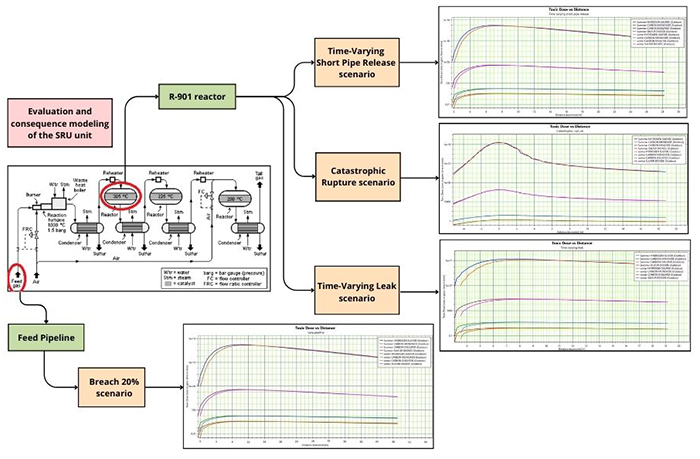
Material and Methods: Consequence modeling was conducted using PHAST version 8.4. Process data, including temperature, pressure, flow rate, and feed composition, along with meteorological conditions (average temperature, relative humidity, and wind speed based on Pasquill stability classification), were used to define probable scenarios. Scenarios included partial pipeline rupture, variable leak flow, short pipe release, and catastrophic reactor tank rupture. Key damage criteria, including thermal radiation threshold, explosion overpressure, and toxic dose, were used to determine hazard zones.
Results: Thermal radiation up to 71.027 kW/m² can cause instant death within a 70-meter radius, while overpressure exceeding 0.206 bar can destroy equipment and structures up to 35 meters in summer conditions. The H₂S cloud can spread up to 120 meters downwind, causing immediate fatalities among exposed personnel. These findings identify high-risk zones in and around the SRU, emphasizing the need to relocate shelters, install gas monitoring systems, and provide protective equipment. Results are limited to the defined scenarios and PHAST assumptions.
Conclusion: Due to the lack of risk assessment studies in early phases and during operation, identifying safe points and high-risk zones, along with prioritizing risk reduction, is essential to ensure workplace and public safety. Comprehensive risk assessment, including probability analysis (using software such as SAFETI) and application of advanced models (CFD and AI-based methods), is recommended for future research.
Material and Methods: Consequence modeling was conducted using PHAST version 8.4. Process data, including temperature, pressure, flow rate, and feed composition, along with meteorological conditions (average temperature, relative humidity, and wind speed based on Pasquill stability classification), were used to define probable scenarios. Scenarios included partial pipeline rupture, variable leak flow, short pipe release, and catastrophic reactor tank rupture. Key damage criteria, including thermal radiation threshold, explosion overpressure, and toxic dose, were used to determine hazard zones.
Results: Thermal radiation up to 71.027 kW/m² can cause instant death within a 70-meter radius, while overpressure exceeding 0.206 bar can destroy equipment and structures up to 35 meters in summer conditions. The H₂S cloud can spread up to 120 meters downwind, causing immediate fatalities among exposed personnel. These findings identify high-risk zones in and around the SRU, emphasizing the need to relocate shelters, install gas monitoring systems, and provide protective equipment. Results are limited to the defined scenarios and PHAST assumptions.
Conclusion: Due to the lack of risk assessment studies in early phases and during operation, identifying safe points and high-risk zones, along with prioritizing risk reduction, is essential to ensure workplace and public safety. Comprehensive risk assessment, including probability analysis (using software such as SAFETI) and application of advanced models (CFD and AI-based methods), is recommended for future research.
Type of Study: Research |
Send email to the article author
| Rights and permissions | |
 |
This work is licensed under a Creative Commons Attribution-NonCommercial 4.0 International License. |