

Volume 16, Issue 1 (3-2026)
J Health Saf Work 2026, 16(1): 119-145 |
Back to browse issues page


Download citation:
BibTeX | RIS | EndNote | Medlars | ProCite | Reference Manager | RefWorks
Send citation to:


BibTeX | RIS | EndNote | Medlars | ProCite | Reference Manager | RefWorks
Send citation to:
Keighobadi E, Ebrahimi H, Vosoughi S, Asgharyan F, Moradi Hanifi S. Identification and Prioritization of Key Factors Influencing Risk Management in Process Industries Using the Fuzzy DANP Method. J Health Saf Work 2026; 16 (1) :119-145
URL: http://jhsw.tums.ac.ir/article-1-7308-en.html
URL: http://jhsw.tums.ac.ir/article-1-7308-en.html
Elham Keighobadi1 
 , Hossein Ebrahimi2 , Shahram Vosoughi2 , Farhad Asgharyan3 , Saber Moradi Hanifi *4
, Hossein Ebrahimi2 , Shahram Vosoughi2 , Farhad Asgharyan3 , Saber Moradi Hanifi *4
1- Occupational Health Research Center, Department of Occupational Health Engineering, School of Public Health, Iran University of Medical Sciences, Tehran, Iran
2- Department of Occupational Health and Safety Engineering, School of Public Health, Iran University of Medical Sciences, Tehran, Iran
3- The Petroleum University of Technology, Abadan, Iran
4- The Petroleum University of Technology, Abadan, Iran ,sabermoradi22@yahoo.com
2- Department of Occupational Health and Safety Engineering, School of Public Health, Iran University of Medical Sciences, Tehran, Iran
3- The Petroleum University of Technology, Abadan, Iran
4- The Petroleum University of Technology, Abadan, Iran ,
Abstract: (85 Views)
Introduction: Process industries are considered to be vital pillars of economic development, but the complexity of their performance and processes poses serious challenges to effective risk management. This study presents an integrated model based on Fuzzy DEMATEL and Fuzzy ANP methods to identify and prioritize key factors affecting risk management in these industries.
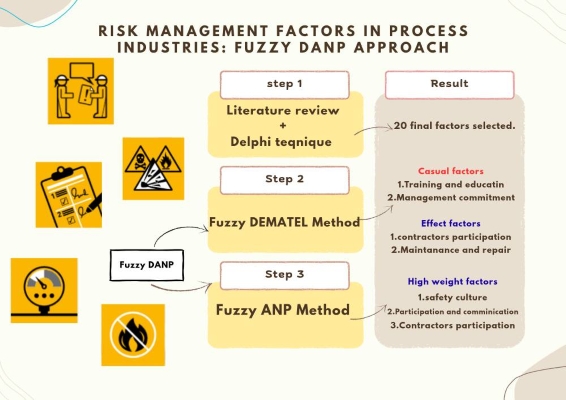
Material and Methods: First, in a systematic literature review, 54 eligible articles were selected from reliable sources between 1995 and 2024, and 23 initial factors affecting risk management were extracted. Then, in three rounds of Delphi technique with the participation of 13 experts with an average work experience of 12.6 years, 20 final factors were confirmed. Subsequently, the Fuzzy DEMATEL method was used to analyze the cause-and-effect relationships between the factors, and the Fuzzy ANP method was used to determine their weight and priority.
Results: The results indicated that 6 factors play a causal role, while 14 factors play an effect role. “Training” and “management commitment” were identified as the most effective causal factors, playing a pivotal role in strengthening other risk management measures. In contrast, “maintenance and repair” and “contractor and stakeholder participation” were the most influenced by other factors. Additionally, “safety culture and climate” obtained the highest weight in the fuzzy network analysis.
Conclusion: By providing a comprehensive picture of the influencing factors and their interactions, the proposed framework provides a practical and strategic tool for managers to improve process safety and manage risks more effectively by focusing on priority factors.
Material and Methods: First, in a systematic literature review, 54 eligible articles were selected from reliable sources between 1995 and 2024, and 23 initial factors affecting risk management were extracted. Then, in three rounds of Delphi technique with the participation of 13 experts with an average work experience of 12.6 years, 20 final factors were confirmed. Subsequently, the Fuzzy DEMATEL method was used to analyze the cause-and-effect relationships between the factors, and the Fuzzy ANP method was used to determine their weight and priority.
Results: The results indicated that 6 factors play a causal role, while 14 factors play an effect role. “Training” and “management commitment” were identified as the most effective causal factors, playing a pivotal role in strengthening other risk management measures. In contrast, “maintenance and repair” and “contractor and stakeholder participation” were the most influenced by other factors. Additionally, “safety culture and climate” obtained the highest weight in the fuzzy network analysis.
Conclusion: By providing a comprehensive picture of the influencing factors and their interactions, the proposed framework provides a practical and strategic tool for managers to improve process safety and manage risks more effectively by focusing on priority factors.
Type of Study: Review |
Send email to the article author
| Rights and permissions | |
 |
This work is licensed under a Creative Commons Attribution-NonCommercial 4.0 International License. |