
Volume 15, Issue 3 (10-2025)
J Health Saf Work 2025, 15(3): 627-650 |
Back to browse issues page



Download citation:
BibTeX | RIS | EndNote | Medlars | ProCite | Reference Manager | RefWorks
Send citation to:


BibTeX | RIS | EndNote | Medlars | ProCite | Reference Manager | RefWorks
Send citation to:
Asghari F, Hemmatjou R, Ghahramani A. Investigation of Human Factors Contributing to Accidents and Unsafe Acts of Employees and Their Prioritization Using HFACS, DEMATEL, and ANP Methods: A Case Study in the Rebar Production Unit of a Steel Manufacturing Company. J Health Saf Work 2025; 15 (3) :627-650
URL: http://jhsw.tums.ac.ir/article-1-7210-en.html
URL: http://jhsw.tums.ac.ir/article-1-7210-en.html


1- Department of Occupational Health, Faculty of Health, Urmia University of Medical Sciences, Urmia, Iran
2- Department of Occupational Health, Faculty of Health, Urmia University of Medical Sciences, Urmia, Iran ,ghahramani@umsu.ac.ir
2- Department of Occupational Health, Faculty of Health, Urmia University of Medical Sciences, Urmia, Iran ,
Abstract: (2918 Views)
Introduction: Unsafe acts are one of the main causes of workplace accidents. Given the critical role of the steel industry in our country, and the limited research on human factors, and the importance of identifying the contributors to accidents, this study was conducted with the aim of identifying human factors influencing accidents and unsafe behaviors using the Human Factors Analysis and Classification System (HFACS). The identified factors were then prioritized using the Decision-Making Trial and Evaluation Laboratory (DEMATEL) and Analytic Network Process (ANP) methods. Based on the results, appropriate recommendations were proposed for the prevention of accidents and the reduction of unsafe acts.
Material and Methods: This descriptive-analytical study was carried out in the rebar production unit of a steel manufacturing plant. Among 35 recorded accidents over the past two years, 28 were related to the rebar production unit. Data were collected through review of accident reports, seven on-site observations during high-risk shifts, and interviews with employees. After analyzing the occupational accidents, the rebar production process in the rolling unit was identified as a high-risk area. The HFACS checklist was used to assess this process and classify the human factors contributing to accidents. Subsequently, DEMATEL and ANP methods were applied to determine causal relationships and prioritize the factors.
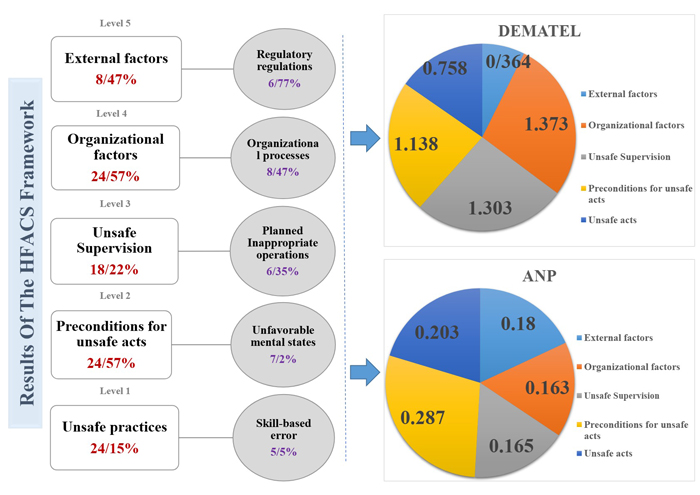
Results: The HFACS analysis identified 236 human factors, among which the preconditions for unsafe acts and organizational factors had the highest frequency (24.57% each), while external factors had the lowest (8.47%). According to DEMATEL results, organizational influences exerted the greatest impact on other levels, whereas external factors had the least effect. In terms of being influenced by other levels, unsafe acts showed the highest level of susceptibility, whereas unsafe supervision had the lowest levels. Based on ANP findings, the preconditions for unsafe acts had the highest importance, while unsafe supervision had the lowest in contributing to unsafe acts.
Conclusion: The findings of this study suggest that improving safety culture, improving organizational regulations, implementing targeted training programs, and updating equipment can play a significant role in reducing accidents caused by unsafe acts. The results provide practical insights for managers and policymakers and can serve as a useful tool for decision-making in occupational health and safety within the steel industry.
Material and Methods: This descriptive-analytical study was carried out in the rebar production unit of a steel manufacturing plant. Among 35 recorded accidents over the past two years, 28 were related to the rebar production unit. Data were collected through review of accident reports, seven on-site observations during high-risk shifts, and interviews with employees. After analyzing the occupational accidents, the rebar production process in the rolling unit was identified as a high-risk area. The HFACS checklist was used to assess this process and classify the human factors contributing to accidents. Subsequently, DEMATEL and ANP methods were applied to determine causal relationships and prioritize the factors.
Results: The HFACS analysis identified 236 human factors, among which the preconditions for unsafe acts and organizational factors had the highest frequency (24.57% each), while external factors had the lowest (8.47%). According to DEMATEL results, organizational influences exerted the greatest impact on other levels, whereas external factors had the least effect. In terms of being influenced by other levels, unsafe acts showed the highest level of susceptibility, whereas unsafe supervision had the lowest levels. Based on ANP findings, the preconditions for unsafe acts had the highest importance, while unsafe supervision had the lowest in contributing to unsafe acts.
Conclusion: The findings of this study suggest that improving safety culture, improving organizational regulations, implementing targeted training programs, and updating equipment can play a significant role in reducing accidents caused by unsafe acts. The results provide practical insights for managers and policymakers and can serve as a useful tool for decision-making in occupational health and safety within the steel industry.
Send email to the article author
| Rights and permissions | |
 |
This work is licensed under a Creative Commons Attribution-NonCommercial 4.0 International License. |