

Volume 15, Issue 3 (10-2025)
J Health Saf Work 2025, 15(3): 687-723 |
Back to browse issues page



Download citation:
BibTeX | RIS | EndNote | Medlars | ProCite | Reference Manager | RefWorks
Send citation to:


BibTeX | RIS | EndNote | Medlars | ProCite | Reference Manager | RefWorks
Send citation to:
Paridokht F, Tabrizi A, Khorshidi behzadi Y, Farhang Dehghan S. Investigating Thermal Comfort and Ventilation in Schools: A Systematic Review. J Health Saf Work 2025; 15 (3) :687-723
URL: http://jhsw.tums.ac.ir/article-1-7213-en.html
URL: http://jhsw.tums.ac.ir/article-1-7213-en.html


1- Student Research Committee, Department of Occupational Health and Safety Engineering, School of Public Health and Safety, Shahid Beheshti University of Medical Sciences, Tehran, Iran
2- Department of Occupational Health and Safety Engineering, School of Public Health and Safety, Shahid Beheshti University of Medical Sciences, Tehran, Iran | Abadan University of Medical Sciences, Abadan, Iran
3- Environmental and Occupational Hazards Control Research Center, Research Institute for Health Sciences and Environment, Shahid Beheshti University of Medical Sciences, Tehran, Iran | School of Public Health and Safety, Shahid Beheshti University of Medical Sciences, Tehran, Iran ,somayeh.farhang@sbmu.ac.ir
2- Department of Occupational Health and Safety Engineering, School of Public Health and Safety, Shahid Beheshti University of Medical Sciences, Tehran, Iran | Abadan University of Medical Sciences, Abadan, Iran
3- Environmental and Occupational Hazards Control Research Center, Research Institute for Health Sciences and Environment, Shahid Beheshti University of Medical Sciences, Tehran, Iran | School of Public Health and Safety, Shahid Beheshti University of Medical Sciences, Tehran, Iran ,
Abstract: (1790 Views)
Introduction: Students play a key role in shaping the future of any society and spend a significant amount of time in educational environments. Creating an optimal learning environment requires close attention to factors affecting student well-being, particularly thermal comfort and indoor air quality. This study aims to systematically review the existing literature on thermal comfort and ventilation systems in schools.
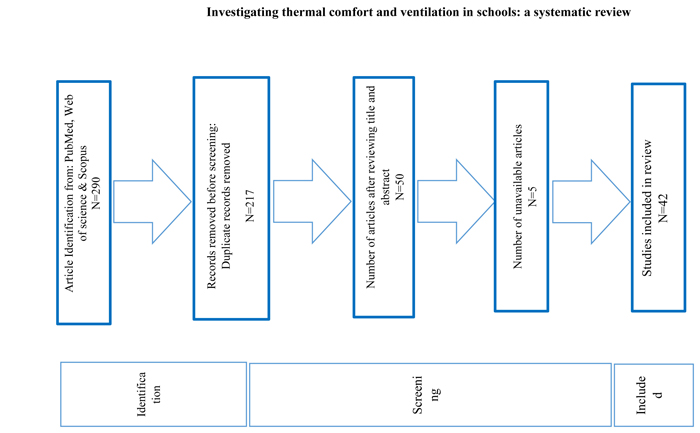
Material and Methods: This systematic review was conducted based on the Cochrane methodology, involving a comprehensive search of three major databases — Scopus, Web of Science, and PubMed — for articles published between 2020 and 2024. The inclusion criteria encompassed peer-reviewed, conference, and review articles published in English that included the keywords “thermal comfort,” “ventilation,” and “school” in their title, abstract, or keywords. Studies focusing on preschools, universities, or other non-primary/secondary educational settings, as well as those conducted during the COVID-19 pandemic, were excluded.
Results: A total of 42 articles were selected after a rigorous screening process. The highest number of publications was reported in 2023. Key findings included: Most studies focused on elementary and secondary schools. The majority of research was conducted during the summer season, which may limit generalizability across seasons. There was considerable variation in CO₂ levels, with some exceeding recommended standards. In simulation studies, DesignBuilder and EnergyPlus were the most frequently used software tools. Additionally, results showed that: Indoor air quality and thermal comfort are significantly influenced by the type of ventilation system. Schools using natural ventilation often experienced higher CO₂ concentrations and lower thermal comfort than recommended. Implementation of Demand-Controlled Ventilation (DCV) has shown promise in improving indoor air quality and reducing pollutant levels.
Conclusion: This paper can contribute to the improvement of educational space design, enhancement of student learning, and promotion of indoor environmental health. It also provides insights into the latest methods for measuring and simulating thermal comfort and indoor air quality. For more practical outcomes, long-term studies with larger sample sizes across different seasons and times of day are needed. Combining computer simulations with real-world measurements can support cost-effective and optimized design of educational spaces. Future research should focus on standardizing temperature, humidity, CO₂ levels, and selecting the most appropriate ventilation strategies for classrooms.
Material and Methods: This systematic review was conducted based on the Cochrane methodology, involving a comprehensive search of three major databases — Scopus, Web of Science, and PubMed — for articles published between 2020 and 2024. The inclusion criteria encompassed peer-reviewed, conference, and review articles published in English that included the keywords “thermal comfort,” “ventilation,” and “school” in their title, abstract, or keywords. Studies focusing on preschools, universities, or other non-primary/secondary educational settings, as well as those conducted during the COVID-19 pandemic, were excluded.
Results: A total of 42 articles were selected after a rigorous screening process. The highest number of publications was reported in 2023. Key findings included: Most studies focused on elementary and secondary schools. The majority of research was conducted during the summer season, which may limit generalizability across seasons. There was considerable variation in CO₂ levels, with some exceeding recommended standards. In simulation studies, DesignBuilder and EnergyPlus were the most frequently used software tools. Additionally, results showed that: Indoor air quality and thermal comfort are significantly influenced by the type of ventilation system. Schools using natural ventilation often experienced higher CO₂ concentrations and lower thermal comfort than recommended. Implementation of Demand-Controlled Ventilation (DCV) has shown promise in improving indoor air quality and reducing pollutant levels.
Conclusion: This paper can contribute to the improvement of educational space design, enhancement of student learning, and promotion of indoor environmental health. It also provides insights into the latest methods for measuring and simulating thermal comfort and indoor air quality. For more practical outcomes, long-term studies with larger sample sizes across different seasons and times of day are needed. Combining computer simulations with real-world measurements can support cost-effective and optimized design of educational spaces. Future research should focus on standardizing temperature, humidity, CO₂ levels, and selecting the most appropriate ventilation strategies for classrooms.
Send email to the article author
| Rights and permissions | |
 |
This work is licensed under a Creative Commons Attribution-NonCommercial 4.0 International License. |