

Volume 15, Issue 4 (12-2025)
J Health Saf Work 2025, 15(4): 780-806 |
Back to browse issues page



Download citation:
BibTeX | RIS | EndNote | Medlars | ProCite | Reference Manager | RefWorks
Send citation to:


BibTeX | RIS | EndNote | Medlars | ProCite | Reference Manager | RefWorks
Send citation to:
Karimi A, Zarei E, Hokmabadi R. Reliability Assessment of Gas Pressure Reduction Stations Based on Monte Carlo Markov Chain and Continuous-Time Markov Chain Methods: A Case Study of a City Gas Pressure Reduction Station. J Health Saf Work 2025; 15 (4) :780-806
URL: http://jhsw.tums.ac.ir/article-1-7256-en.html
URL: http://jhsw.tums.ac.ir/article-1-7256-en.html


1- Department of Occupational Health, School of Public Health, Tehran University of Medical Sciences, Tehran, Iran
2- Department of Safety Science, College of Aviation, Embry-Riddle Aeronautical University, Prescott, AZ 86301, USA. | Robertson Safety Institute (RSI), Embry-Riddle Aeronautical University, Prescott, AZ, 86301, USA
3- Department of Occupational Health Engineering, School of Public Health, North Khorasan University of Medical Sciences, Bojnurd, Iran ,abi.hse2006@gmail.com
2- Department of Safety Science, College of Aviation, Embry-Riddle Aeronautical University, Prescott, AZ 86301, USA. | Robertson Safety Institute (RSI), Embry-Riddle Aeronautical University, Prescott, AZ, 86301, USA
3- Department of Occupational Health Engineering, School of Public Health, North Khorasan University of Medical Sciences, Bojnurd, Iran ,
Abstract: (854 Views)
Introduction: A gas pressure reduction station is an important facility in gas transmission systems. These systems consist of various sections, the reliability of each section affecting the station’s overall reliability. Therefore, this study aimed to assess the reliability of station sections using Markov chain Monte Carlo (MCMC) and the continuous-time Markov chain (CTMC) method.
Material and Methods: Equipment failure and repair rates were simulated using the MCMC method in WinBUGS14. Then, based on the failure and repair rates, the station reliability was evaluated using the CTMC. The results of the equipment failure rate simulation were validated using two criteria: MC Error and the Goleman-Rubin test. Also, the results of station reliability evaluation were validated using Reality Check and Partial Benchmark Exercise methods.
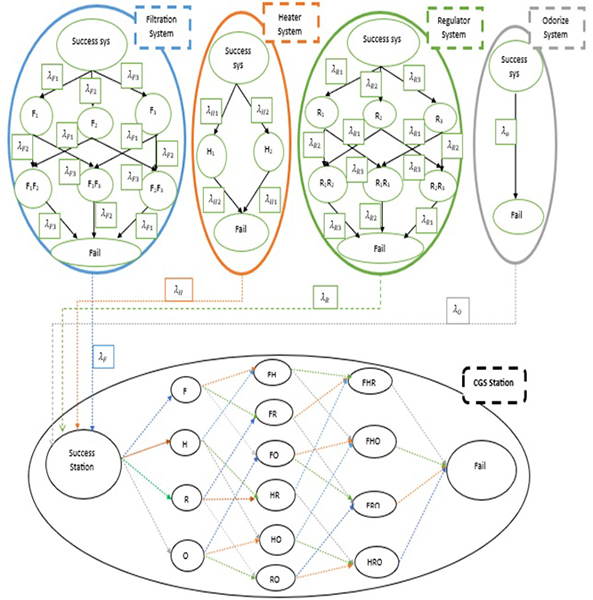
Results: Failures in the filtration and pressure reduction sections were more frequent than in other sections of the station. Therefore, these sections were considered the most critical sections in the reliability assessment. The posterior standard error was less than 0.01, indicating good convergence of the data for the parameter posterior distribution. The results of the Goleman-Rabin test showed values less than 1.2, indicating proper convergence of the chains. For all sections and stations, a systematic approach was determined using the Markov model. The results showed a strong correlation between the CTMC and the block diagram method (R2=0.9499).
Conclusion: The proposed approach combines failures of system components and can display multiple failures. It also accounts for time factors in its calculations and minimizes subjective expert evaluations.
Material and Methods: Equipment failure and repair rates were simulated using the MCMC method in WinBUGS14. Then, based on the failure and repair rates, the station reliability was evaluated using the CTMC. The results of the equipment failure rate simulation were validated using two criteria: MC Error and the Goleman-Rubin test. Also, the results of station reliability evaluation were validated using Reality Check and Partial Benchmark Exercise methods.
Results: Failures in the filtration and pressure reduction sections were more frequent than in other sections of the station. Therefore, these sections were considered the most critical sections in the reliability assessment. The posterior standard error was less than 0.01, indicating good convergence of the data for the parameter posterior distribution. The results of the Goleman-Rabin test showed values less than 1.2, indicating proper convergence of the chains. For all sections and stations, a systematic approach was determined using the Markov model. The results showed a strong correlation between the CTMC and the block diagram method (R2=0.9499).
Conclusion: The proposed approach combines failures of system components and can display multiple failures. It also accounts for time factors in its calculations and minimizes subjective expert evaluations.
Keywords: Reliability, Continuous Time Markov Chain (CTMC) Method, Markov Chain Monte Carlo (MCMC) Method, National Gas Pressure Reducing Station
Type of Study: Research |
Send email to the article author
| Rights and permissions | |
 |
This work is licensed under a Creative Commons Attribution-NonCommercial 4.0 International License. |