

Volume 15, Issue 4 (12-2025)
J Health Saf Work 2025, 15(4): 864-886 |
Back to browse issues page



Download citation:
BibTeX | RIS | EndNote | Medlars | ProCite | Reference Manager | RefWorks
Send citation to:


BibTeX | RIS | EndNote | Medlars | ProCite | Reference Manager | RefWorks
Send citation to:
Jafarizaveh M, Jafari A, Jafari Nodoushan M, Chambari F, Golbabaei F. Analyzing the Impact of Climate Change on Heat Stress Levels among Workers in the National Steel Industry. J Health Saf Work 2025; 15 (4) :864-886
URL: http://jhsw.tums.ac.ir/article-1-7260-en.html
URL: http://jhsw.tums.ac.ir/article-1-7260-en.html
Mostafa Jafarizaveh1 
 , Ali Jafari2 , Mahdi Jafari Nodoushan3 , Fatemeh Chambari4 , Farideh Golbabaei *5
, Ali Jafari2 , Mahdi Jafari Nodoushan3 , Fatemeh Chambari4 , Farideh Golbabaei *5
1- Department of Occupational Health engineering, School of Public Health, Tehran University of Medical Sciences, Tehran, Iran | Department of Occupational Health Engineering, School of Public Health, Gonabad University of Medical Sciences, Gonabad, Iran
2- Department of Occupational Health engineering, School of Public Health, Tehran University of Medical Sciences, Tehran, Iran
3- Department of Occupational Health engineering, School of Public Health, Tehran University of Medical Sciences, Tehran, Iran | Industrial Diseases Research Center, Shahid Sadoughi University of Medical Sciences, Yazd, Iran
4- Department of Environmental Health Engineering, School of Public Health, Tehran University of Medical Sciences, Tehran, Iran
5- Department of Occupational Health engineering, School of Public Health, Tehran University of Medical Sciences, Tehran, Iran ,fgolbabaei@tums.ac.ir
2- Department of Occupational Health engineering, School of Public Health, Tehran University of Medical Sciences, Tehran, Iran
3- Department of Occupational Health engineering, School of Public Health, Tehran University of Medical Sciences, Tehran, Iran | Industrial Diseases Research Center, Shahid Sadoughi University of Medical Sciences, Yazd, Iran
4- Department of Environmental Health Engineering, School of Public Health, Tehran University of Medical Sciences, Tehran, Iran
5- Department of Occupational Health engineering, School of Public Health, Tehran University of Medical Sciences, Tehran, Iran ,
Abstract: (739 Views)
Introduction: Climate change is a major global challenge, strongly influencing the Wet Bulb Globe Temperature (WBGT) index and heat stress among steel industry workers. This study evaluates the impact of geographical location and climate change on occupational heat stress exposure in Iran’s steel sector.
Material and Methods: This qualitative-analytical study used data from the SABA system and the Iranian Occupational Heat Stress Atlas. Information on steel industries, their distribution, and production capacities across eight climate zones was extracted. WBGT measurements were collected in collaboration with industrial units in different zones. Data analysis was performed using ArcGIS and SPSS. The effects of climate change on heat stress were assessed for three future horizons: 2040, 2060, and 2080.
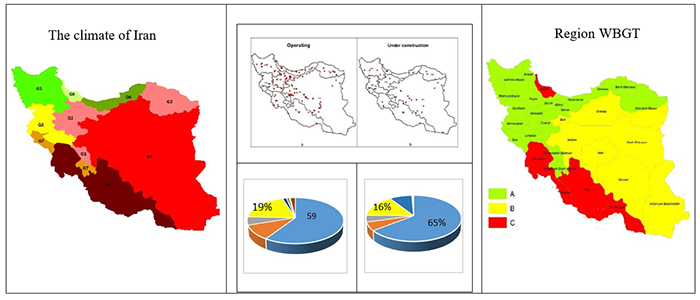
Results: The findings revealed that climate zones G1 (eastern, southeastern, and desert regions) and G4 (Persian Gulf coastal provinces including Hormozgan, Bushehr, Fars, and Khuzestan), which host the highest steel production capacities, are exposed to the highest levels of heat stress (WBGT index) and water resource scarcity. WBGT values in zones G4 and G6 (Gilan province) exceeded permissible limits, whereas zones G2 (including North Khorasan, Razavi Khorasan, Tehran, Alborz, Qazvin, Hamedan, Markazi, and Chaharmahal-Bakhtiari), G5 (Kurdistan, Kermanshah, Lorestan), and G7 (Ilam, Kohgiluyeh and Boyer-Ahmad) showed the lowest WBGT levels. Considering projected temperature increases in the three future horizons and the acceptable correlation coefficient (0.40) between annual daytime temperature and WBGT index per climate zone, predicted temperature changes may lead to increased WBGT levels, particularly in zones G3, G6, and G8.
Conclusion: Given climate projections and the spatial distribution of steel industries, it is essential to develop climate-responsive policies, implement sustainable water resource management, and reconsider the siting of steel production units. These measures can enhance the resilience of Iran’s steel industry against future climate change and mitigate occupational health and environmental risks.
Material and Methods: This qualitative-analytical study used data from the SABA system and the Iranian Occupational Heat Stress Atlas. Information on steel industries, their distribution, and production capacities across eight climate zones was extracted. WBGT measurements were collected in collaboration with industrial units in different zones. Data analysis was performed using ArcGIS and SPSS. The effects of climate change on heat stress were assessed for three future horizons: 2040, 2060, and 2080.
Results: The findings revealed that climate zones G1 (eastern, southeastern, and desert regions) and G4 (Persian Gulf coastal provinces including Hormozgan, Bushehr, Fars, and Khuzestan), which host the highest steel production capacities, are exposed to the highest levels of heat stress (WBGT index) and water resource scarcity. WBGT values in zones G4 and G6 (Gilan province) exceeded permissible limits, whereas zones G2 (including North Khorasan, Razavi Khorasan, Tehran, Alborz, Qazvin, Hamedan, Markazi, and Chaharmahal-Bakhtiari), G5 (Kurdistan, Kermanshah, Lorestan), and G7 (Ilam, Kohgiluyeh and Boyer-Ahmad) showed the lowest WBGT levels. Considering projected temperature increases in the three future horizons and the acceptable correlation coefficient (0.40) between annual daytime temperature and WBGT index per climate zone, predicted temperature changes may lead to increased WBGT levels, particularly in zones G3, G6, and G8.
Conclusion: Given climate projections and the spatial distribution of steel industries, it is essential to develop climate-responsive policies, implement sustainable water resource management, and reconsider the siting of steel production units. These measures can enhance the resilience of Iran’s steel industry against future climate change and mitigate occupational health and environmental risks.
Type of Study: Research |
Send email to the article author
| Rights and permissions | |
 |
This work is licensed under a Creative Commons Attribution-NonCommercial 4.0 International License. |