

Volume 15, Issue 4 (12-2025)
J Health Saf Work 2025, 15(4): 887-903 |
Back to browse issues page



Download citation:
BibTeX | RIS | EndNote | Medlars | ProCite | Reference Manager | RefWorks
Send citation to:


BibTeX | RIS | EndNote | Medlars | ProCite | Reference Manager | RefWorks
Send citation to:
Batooli Z, Asghar Khajevandi A, Motalebi Kashani M, Akbari H, Mohammadfam I, Azizian Shahrivar R. Structural Equation Modeling of the Relationships Between Safety Climate, Self-Determined Safety Motivation, and Safety Behavior in a High-Risk Industry. J Health Saf Work 2025; 15 (4) :887-903
URL: http://jhsw.tums.ac.ir/article-1-7261-en.html
URL: http://jhsw.tums.ac.ir/article-1-7261-en.html
Zahra Batooli1 
 , Ali Asghar Khajevandi1 , Masoud Motalebi Kashani1 , Hossein Akbari2 , Iraj Mohammadfam3 , Rasoul Azizian Shahrivar *4
, Ali Asghar Khajevandi1 , Masoud Motalebi Kashani1 , Hossein Akbari2 , Iraj Mohammadfam3 , Rasoul Azizian Shahrivar *4
1- Social Determinants of Health (SDH) Research Center, Faculty of Health, Kashan University of Medical Sciences, Kashan, Iran
2- Social Determinants of Health (SDH) Research Center, Kashan University of Medical Sciences, Kashan, Iran
3- Department of Ergonomic, Health in Emergency and Disaster Research Center, University of Social Welfare and Rehabilitation Science, Tehran, Iran
4- ,Rasoulsafety@gmail.com
2- Social Determinants of Health (SDH) Research Center, Kashan University of Medical Sciences, Kashan, Iran
3- Department of Ergonomic, Health in Emergency and Disaster Research Center, University of Social Welfare and Rehabilitation Science, Tehran, Iran
4- ,
Abstract: (974 Views)
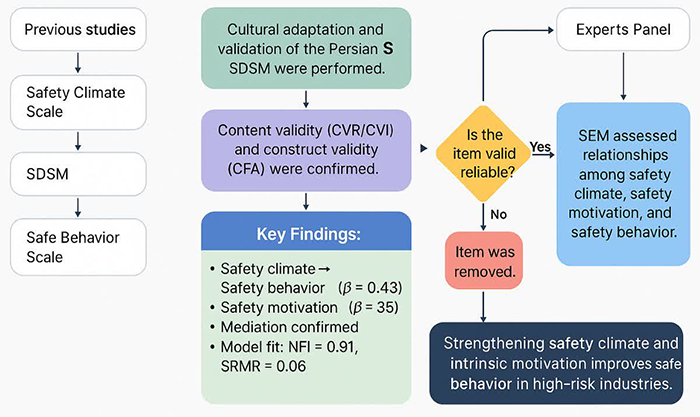
Introduction: Workplace safety is a critical factor for organizational success and the protection of human capital. Safe behavior among employees is influenced by various psychological and organizational factors, including safety climate and safety motivation. Considering the importance of enhancing safety motivation and the lack of standardized indigenous tools in Iran, this study aimed to culturally adapt the Self-Determination Safety Motivation Scale (SDSM) and examine its mediating role in the relationship between safety climate and employees’ safe behavior at Kavir Steel Complex in Aran and Bidgol County.
Material and Methods: This analytical cross-sectional study was conducted in 2024 among 256 production line employees. Data were collected using the Safety Climate Questionnaire, the Safe Behavior Questionnaire, and the Persian-adapted SDSM. The adaptation process included forward–backward translation, content validity evaluation by experts, and confirmatory factor analysis. Data were analyzed using SPSS version 26 and structural equation modeling with SmartPLS version 4.
Results: The findings indicated that safety climate had a positive and significant effect on safe behavior (β = 0.608, p < 0.001), and safety motivation significantly mediated this relationship (β = 0.388, p < 0.001). It is noteworthy that the direct relationship between safety climate and safety motivation was significantly negative. The structural model explained approximately 42% of the variance in safety behavior (R² = 0.419), indicating satisfactory predictive power. Model fit indices (NFI = 0.91, SRMR = 0.06) demonstrated a satisfactory model fit. Convergent validity, discriminant validity, and construct reliability were all confirmed at acceptable levels.
Conclusion: The results highlight the importance of fostering a positive safety climate and strengthening employees’ intrinsic motivation in high-risk environments to reduce workplace accidents and promote organizational health. These findings can serve as a foundation for policy-making and training programs in the field of HSE.
Material and Methods: This analytical cross-sectional study was conducted in 2024 among 256 production line employees. Data were collected using the Safety Climate Questionnaire, the Safe Behavior Questionnaire, and the Persian-adapted SDSM. The adaptation process included forward–backward translation, content validity evaluation by experts, and confirmatory factor analysis. Data were analyzed using SPSS version 26 and structural equation modeling with SmartPLS version 4.
Results: The findings indicated that safety climate had a positive and significant effect on safe behavior (β = 0.608, p < 0.001), and safety motivation significantly mediated this relationship (β = 0.388, p < 0.001). It is noteworthy that the direct relationship between safety climate and safety motivation was significantly negative. The structural model explained approximately 42% of the variance in safety behavior (R² = 0.419), indicating satisfactory predictive power. Model fit indices (NFI = 0.91, SRMR = 0.06) demonstrated a satisfactory model fit. Convergent validity, discriminant validity, and construct reliability were all confirmed at acceptable levels.
Conclusion: The results highlight the importance of fostering a positive safety climate and strengthening employees’ intrinsic motivation in high-risk environments to reduce workplace accidents and promote organizational health. These findings can serve as a foundation for policy-making and training programs in the field of HSE.
Keywords: Safety motivation, Safety climate, Safe behavior, Self-determination theory, Structural equation modeling, Scale validation
Type of Study: Research |
Send email to the article author
| Rights and permissions | |
 |
This work is licensed under a Creative Commons Attribution-NonCommercial 4.0 International License. |