

Volume 15, Issue 4 (12-2025)
J Health Saf Work 2025, 15(4): 960-974 |
Back to browse issues page



Download citation:
BibTeX | RIS | EndNote | Medlars | ProCite | Reference Manager | RefWorks
Send citation to:


BibTeX | RIS | EndNote | Medlars | ProCite | Reference Manager | RefWorks
Send citation to:
Rezaei-Hachesu V, Jafari A, Naderyan Fe’li S. Prevalence of Diabetes Among Individuals Exposed to Occupational Noise: A Systematic Review and Meta-Analysis. J Health Saf Work 2025; 15 (4) :960-974
URL: http://jhsw.tums.ac.ir/article-1-7264-en.html
URL: http://jhsw.tums.ac.ir/article-1-7264-en.html


1- Department of Occupational Health, School of Public Health, Tehran University of Medical Sciences, Tehran, Iran
2- Blood Transfusion Research Center, High Institute for Research and Education in Transfusion Medicine, Tehran, Iran ,Naderyan67@gmail.com
2- Blood Transfusion Research Center, High Institute for Research and Education in Transfusion Medicine, Tehran, Iran ,
Abstract: (841 Views)
Introduction: Occupational noise is considered as an emerging risk factor for type 2 diabetes. Although previous studies have mainly examined the auditory outcomes of noise exposure and estimated the relative risk of diabetes, there is insufficient evidence to estimate the prevalence of type 2 diabetes in Workers exposed to occupational noise. The present study aimed to conduct a systematic review and meta-analysis of the pooled prevalence of type 2 diabetes in workers exposed to occupational noise.
Material and Methods: In this systematic review and meta-analysis, the Web of Science, Scopus, Medline (PubMed) databases and Google Scholar engine were searched up to May 2025. The quality of studies was assessed using the Newcastle-Ottawa scale. The pooled prevalence was estimated using the DerSimonian and Laird random effects model, and heterogeneity was assessed using the I² index. The pooled prevalence was reported in subgroups based on the method of diabetes diagnosis and type of study.
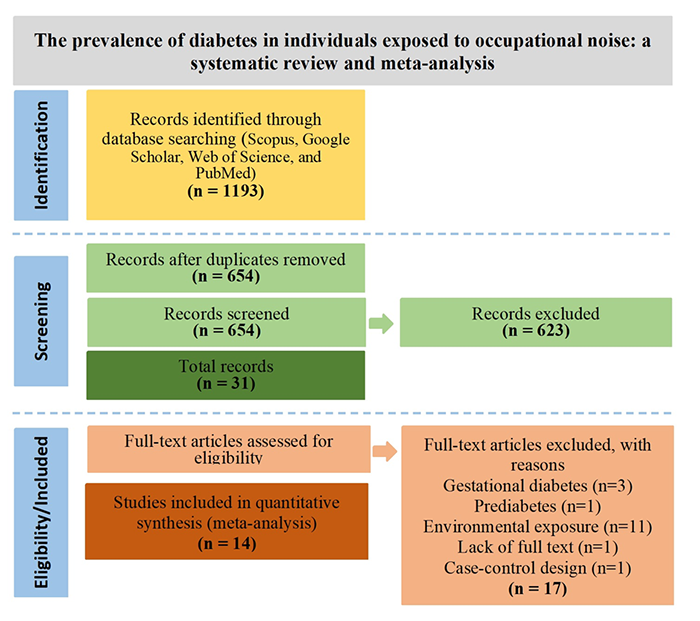
Results: Out of 1,193 initially identified studies, 14 studies with a total of 94,975 participants were included in the systematic review and meta-analysis. The pooled prevalence of type 2 diabetes among individuals exposed to occupational noise was estimated at 5.91% (95% CI: 4.85%–6.98%). Significant statistical heterogeneity was observed among studies (I² = 98%, p < 0.001). The subgroup analysis indicated that the prevalence of diabetes in studies based on clinical or paraclinical diagnostics was higher than in studies based on self-report (7.31% and 3.73%, respectively). Moreover, the prevalence of diabetes in cross-sectional studies was higher than in cohort studies (6.45% and 5.67%, respectively).
Conclusion: The findings indicated a moderate prevalence of diabetes among people exposed to occupational noise. This prevalence was based on preliminary studies with an acceptable level of quality. The findings highlight the importance of recognizing metabolic consequences of occupational noise exposure alongside its well-known auditory effects.
Material and Methods: In this systematic review and meta-analysis, the Web of Science, Scopus, Medline (PubMed) databases and Google Scholar engine were searched up to May 2025. The quality of studies was assessed using the Newcastle-Ottawa scale. The pooled prevalence was estimated using the DerSimonian and Laird random effects model, and heterogeneity was assessed using the I² index. The pooled prevalence was reported in subgroups based on the method of diabetes diagnosis and type of study.
Results: Out of 1,193 initially identified studies, 14 studies with a total of 94,975 participants were included in the systematic review and meta-analysis. The pooled prevalence of type 2 diabetes among individuals exposed to occupational noise was estimated at 5.91% (95% CI: 4.85%–6.98%). Significant statistical heterogeneity was observed among studies (I² = 98%, p < 0.001). The subgroup analysis indicated that the prevalence of diabetes in studies based on clinical or paraclinical diagnostics was higher than in studies based on self-report (7.31% and 3.73%, respectively). Moreover, the prevalence of diabetes in cross-sectional studies was higher than in cohort studies (6.45% and 5.67%, respectively).
Conclusion: The findings indicated a moderate prevalence of diabetes among people exposed to occupational noise. This prevalence was based on preliminary studies with an acceptable level of quality. The findings highlight the importance of recognizing metabolic consequences of occupational noise exposure alongside its well-known auditory effects.
Type of Study: Review |
Send email to the article author
| Rights and permissions | |
 |
This work is licensed under a Creative Commons Attribution-NonCommercial 4.0 International License. |