

Volume 16, Issue 1 (3-2026)
J Health Saf Work 2026, 16(1): 1-22 |
Back to browse issues page


Download citation:
BibTeX | RIS | EndNote | Medlars | ProCite | Reference Manager | RefWorks
Send citation to:


BibTeX | RIS | EndNote | Medlars | ProCite | Reference Manager | RefWorks
Send citation to:
Heidarzadeh M, Farzinpour A, Esmat Saatloo S J, Omidvar M, Abbaspour S, Rezaei A, et al . Predictive and Diagnostic Modeling of Noise Exposure, Hearing Loss, and Systemic Health Impacts Using a Bayesian Network Model: A Case Study of Petrochemical Workers in the South Pars Region. J Health Saf Work 2026; 16 (1) :1-22
URL: http://jhsw.tums.ac.ir/article-1-7301-en.html
URL: http://jhsw.tums.ac.ir/article-1-7301-en.html
Mohammadreza Heidarzadeh1 
 , Ardavan Farzinpour1 , Seyed Jafar Esmat Saatloo1 , Mohsen Omidvar *2 , Siamak Abbaspour1 , Akbar Rezaei1 , Ali Zeinabi1 , Sajad Zare
, Ardavan Farzinpour1 , Seyed Jafar Esmat Saatloo1 , Mohsen Omidvar *2 , Siamak Abbaspour1 , Akbar Rezaei1 , Ali Zeinabi1 , Sajad Zare
1- Arya Sasol Polymer Company, Bushehr, Iran
2- Department of Health, Safety, and Environment (HSE), Faculty of HSEEM, Bushehr University of Medical Sciences, Bushehr, Iran ,m.omidvar@bpums.ac.ir
2- Department of Health, Safety, and Environment (HSE), Faculty of HSEEM, Bushehr University of Medical Sciences, Bushehr, Iran ,
Abstract: (88 Views)
Introduction: Noise‑Induced Hearing Loss (NIHL) is one of the major occupational health concerns. Prolonged exposure to high noise levels not only damages auditory function but also contributes to systemic physiological disorders. This study employed the dual predictive and diagnostic capabilities of a Bayesian Network (BN) to explore the complex interactions between causal factors of NIHL and the physiological outcomes of occupational noise exposure.
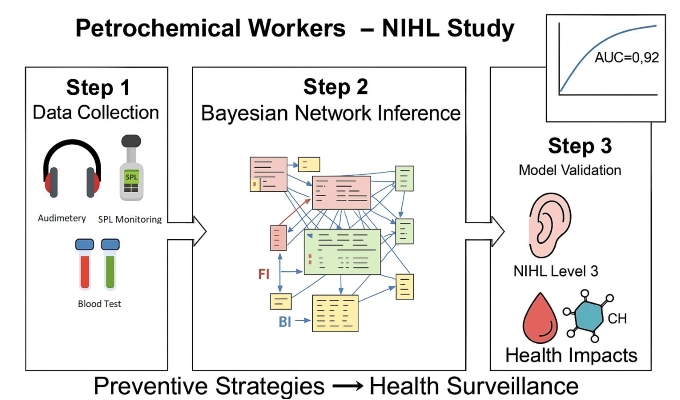
Material and Methods: In this cross‑sectional study, medical and environmental records of 828 petrochemical workers were collected, including demographic, audiometric, noise, hematological, and biochemical variables. After preprocessing, an inferential BN model was developed using the Bayesian Search algorithm, enabling both Forward Inference (FI, predictive) and Backward Inference (BI, diagnostic) reasoning. Model performance was validated through Receiver Operating Characteristic (ROC) curve analysis and sensitivity testing.
Results: The FI results showed that exposure to SPL levels above 85 dB increased the risk of severe NIHL (warning level) from 9% to 57%. Also, the probability of systolic hypertension, the FBS above 100 mg/dL, and the total cholesterol above 200 mg/dL increased from 6%to10%, 8%to18%, 5% to 9% respectively. When multiple high‑risk conditions (e.g., high SPL, long work experience, noisy units) were combined, the probability of severe NIHL exceeded 70%, accompanied by cumulative metabolic disturbances. BI results indicated that the presence of severe NIHL significantly increased the posterior probability of previous exposure to high or borderline SPL levels. Moreover, metabolic indices such as triglycerides (TG) and fasting blood sugar (FBS) showed positive associations with noise exposure, even below conventional action thresholds.
Conclusion: Bayesian networks provide a powerful framework for identifying and modeling direct and indirect probabilistic dependencies between occupational noise exposure and health outcomes in industrial environments. Their bidirectional inference ability (FI and BI) enhances predictive surveillance, early diagnosis, and the design of evidence‑based preventive strategies in occupational health management.
Material and Methods: In this cross‑sectional study, medical and environmental records of 828 petrochemical workers were collected, including demographic, audiometric, noise, hematological, and biochemical variables. After preprocessing, an inferential BN model was developed using the Bayesian Search algorithm, enabling both Forward Inference (FI, predictive) and Backward Inference (BI, diagnostic) reasoning. Model performance was validated through Receiver Operating Characteristic (ROC) curve analysis and sensitivity testing.
Results: The FI results showed that exposure to SPL levels above 85 dB increased the risk of severe NIHL (warning level) from 9% to 57%. Also, the probability of systolic hypertension, the FBS above 100 mg/dL, and the total cholesterol above 200 mg/dL increased from 6%to10%, 8%to18%, 5% to 9% respectively. When multiple high‑risk conditions (e.g., high SPL, long work experience, noisy units) were combined, the probability of severe NIHL exceeded 70%, accompanied by cumulative metabolic disturbances. BI results indicated that the presence of severe NIHL significantly increased the posterior probability of previous exposure to high or borderline SPL levels. Moreover, metabolic indices such as triglycerides (TG) and fasting blood sugar (FBS) showed positive associations with noise exposure, even below conventional action thresholds.
Conclusion: Bayesian networks provide a powerful framework for identifying and modeling direct and indirect probabilistic dependencies between occupational noise exposure and health outcomes in industrial environments. Their bidirectional inference ability (FI and BI) enhances predictive surveillance, early diagnosis, and the design of evidence‑based preventive strategies in occupational health management.
Keywords: Noise-induced hearing loss, Bayesian network, Petrochemical, Cholesterol, Blood pressure, Predictive and diagnostic modeling
Type of Study: Review |
Send email to the article author
| Rights and permissions | |
 |
This work is licensed under a Creative Commons Attribution-NonCommercial 4.0 International License. |