

Volume 16, Issue 1 (3-2026)
J Health Saf Work 2026, 16(1): 23-42 |
Back to browse issues page



Download citation:
BibTeX | RIS | EndNote | Medlars | ProCite | Reference Manager | RefWorks
Send citation to:


BibTeX | RIS | EndNote | Medlars | ProCite | Reference Manager | RefWorks
Send citation to:
Biabani A, Bagherzadeh R, Kalantary S, Rahimi Foroushani A, Golbabaei F. Feasibility Study of Using PDLLA Polymer in the Production of Biodegradable Nanofibrous Media for Capturing Particulate Air Pollutants. J Health Saf Work 2026; 16 (1) :23-42
URL: http://jhsw.tums.ac.ir/article-1-7303-en.html
URL: http://jhsw.tums.ac.ir/article-1-7303-en.html
Azam Biabani1 
 , Roohollah Bagherzadeh2 , Saba Kalantary1 , Abbas Rahimi Foroushani3 , Farideh Golbabaei *4
, Roohollah Bagherzadeh2 , Saba Kalantary1 , Abbas Rahimi Foroushani3 , Farideh Golbabaei *4
1- Department of Occupational Health Engineering, School of Public Health, Tehran University of Medical Sciences, Tehran, Iran
2- Advanced Fibrous Materials Lab (AFM-LAB), Institute for Advanced Textile Materials and Technology, Amirkabir University of Technology (Tehran Polytechnic), Tehran, Iran
3- Department of Epidemiology and Biostatistics, School of Public Health, Tehran University of Medical Sciences, Tehran, Iran
4- Department of Occupational Health Engineering, School of Public Health, Tehran University of Medical Sciences, Tehran, Iran ,fgolbabaei@tums.ac.ir
2- Advanced Fibrous Materials Lab (AFM-LAB), Institute for Advanced Textile Materials and Technology, Amirkabir University of Technology (Tehran Polytechnic), Tehran, Iran
3- Department of Epidemiology and Biostatistics, School of Public Health, Tehran University of Medical Sciences, Tehran, Iran
4- Department of Occupational Health Engineering, School of Public Health, Tehran University of Medical Sciences, Tehran, Iran ,
Abstract: (61 Views)
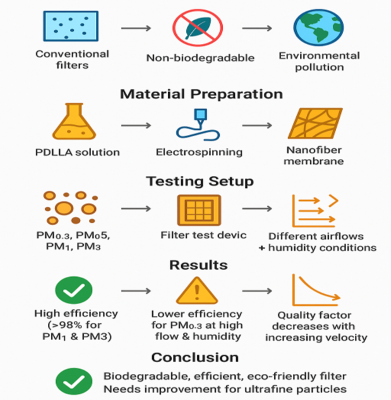
Introduction: Air filters are often made from non-biodegradable substrates, which can lead to significant environmental pollution. Therefore, the use of biodegradable polymers in the development of filtration media is of particular importance. The aim of the present study was to fabricate and evaluate a PDLLA nanofibrous substrate for the adsorption of airborne particulate matter.
Material and Methods: This experimental research was conducted in the Occupational Health Laboratory, School of Public Health, Tehran University of Medical Sciences. The optimal electrospinning conditions for the PDLLA nanofibrous substrate were determined based on a review of previous literature. Subsequently, its filtration efficiency in removing PM0.3, PM0.5, PM1, and PM3 particles was investigated. Tests were performed at three airflow rates: 1.67, 5.3, and 14.16 cm/s, using an FT200PS device. Furthermore, to assess performance stability in humid environments, samples were exposed to relative humidity levels of 75±5% and 55±5% for 30 minutes. The data were analyzed using the Bonferroni post-hoc test within a one-way ANOVA framework.
Results: The optimal electrospinning conditions were obtained at a concentration of 16%, a voltage of 20 kV, an injection rate of 0.5 ml/h, and a tip-to-collector distance of 17 cm. The results showed that the filtration efficiency for PM0.5, PM1, and PM3 particles was consistently above 98%. For PM0.3 particles, the efficiency was over 99% at a velocity of 1.67 cm/s, but it decreased to approximately 96% with an increase in flow velocity to 14.16 cm/s. The quality factor for PM1 and PM3 decreased from 0.529 pa⁻¹ to 0.038 pa⁻¹, and for PM0.3, it decreased from 0.22 pa⁻¹ to 0.011 pa⁻¹. Also, humidity had a slight effect on the filtration of PM0.5, but for PM0.3, a decrease in efficiency was evident.
Conclusion: The PDLLA nanofibrous substrate, under optimal conditions, demonstrated very high efficiency in filtering fine particles, particularly PM1 and PM3. However, increasing the airflow velocity led to a decrease in the quality factor, and the substrate’s performance was more limited when encountering very fine PM0.3 particles and high humidity.
Material and Methods: This experimental research was conducted in the Occupational Health Laboratory, School of Public Health, Tehran University of Medical Sciences. The optimal electrospinning conditions for the PDLLA nanofibrous substrate were determined based on a review of previous literature. Subsequently, its filtration efficiency in removing PM0.3, PM0.5, PM1, and PM3 particles was investigated. Tests were performed at three airflow rates: 1.67, 5.3, and 14.16 cm/s, using an FT200PS device. Furthermore, to assess performance stability in humid environments, samples were exposed to relative humidity levels of 75±5% and 55±5% for 30 minutes. The data were analyzed using the Bonferroni post-hoc test within a one-way ANOVA framework.
Results: The optimal electrospinning conditions were obtained at a concentration of 16%, a voltage of 20 kV, an injection rate of 0.5 ml/h, and a tip-to-collector distance of 17 cm. The results showed that the filtration efficiency for PM0.5, PM1, and PM3 particles was consistently above 98%. For PM0.3 particles, the efficiency was over 99% at a velocity of 1.67 cm/s, but it decreased to approximately 96% with an increase in flow velocity to 14.16 cm/s. The quality factor for PM1 and PM3 decreased from 0.529 pa⁻¹ to 0.038 pa⁻¹, and for PM0.3, it decreased from 0.22 pa⁻¹ to 0.011 pa⁻¹. Also, humidity had a slight effect on the filtration of PM0.5, but for PM0.3, a decrease in efficiency was evident.
Conclusion: The PDLLA nanofibrous substrate, under optimal conditions, demonstrated very high efficiency in filtering fine particles, particularly PM1 and PM3. However, increasing the airflow velocity led to a decrease in the quality factor, and the substrate’s performance was more limited when encountering very fine PM0.3 particles and high humidity.
Type of Study: Review |
Send email to the article author
| Rights and permissions | |
 |
This work is licensed under a Creative Commons Attribution-NonCommercial 4.0 International License. |