

Volume 16, Issue 1 (3-2026)
J Health Saf Work 2026, 16(1): 43-55 |
Back to browse issues page



Download citation:
BibTeX | RIS | EndNote | Medlars | ProCite | Reference Manager | RefWorks
Send citation to:


BibTeX | RIS | EndNote | Medlars | ProCite | Reference Manager | RefWorks
Send citation to:
Khanlari P, NoorbalaTafti A, Ghasemi F, Ghiyasvandian S, Azam K, Zakerian S A. Identification and Ranking of Factors Related to Mental Health Problems in Healthcare Workers from the Perspective of Stakeholders and Experts. J Health Saf Work 2026; 16 (1) :43-55
URL: http://jhsw.tums.ac.ir/article-1-7304-en.html
URL: http://jhsw.tums.ac.ir/article-1-7304-en.html
Payam Khanlari1 
 , AhmadAli NoorbalaTafti2 , Fakhradin Ghasemi , Shahrzad Ghiyasvandian3 , Kamal Azam4 , Seyed Abolfazl Zakerian *5
, AhmadAli NoorbalaTafti2 , Fakhradin Ghasemi , Shahrzad Ghiyasvandian3 , Kamal Azam4 , Seyed Abolfazl Zakerian *5
1- Department of Occupational Health Engineering, School of Public Health, Tehran University of Medical Sciences, Tehran, Iran
2- Department of Psychiatry, School of Medicine, Psychosomatic Medicine Research Center, Tehran University of Medical Sciences, Tehran, Iran
3- Department of Medical-Surgical Nursing and Basic Sciences, School of Nursing & Midwifery, Tehran University of Medical Sciences, Tehran, Iran
4- Department of Epidemiology and Biostatistics, School of Public Health, Tehran University of Medical Sciences, Tehran, Iran
5- Department of Occupational Health Engineering, School of Public Health, Tehran University of Medical Sciences, Tehran, Iran ,zakerian@tums.ac.ir
2- Department of Psychiatry, School of Medicine, Psychosomatic Medicine Research Center, Tehran University of Medical Sciences, Tehran, Iran
3- Department of Medical-Surgical Nursing and Basic Sciences, School of Nursing & Midwifery, Tehran University of Medical Sciences, Tehran, Iran
4- Department of Epidemiology and Biostatistics, School of Public Health, Tehran University of Medical Sciences, Tehran, Iran
5- Department of Occupational Health Engineering, School of Public Health, Tehran University of Medical Sciences, Tehran, Iran ,
Abstract: (82 Views)
Introduction: Healthcare workers face high rates of depression and anxiety due to job-related stressors, which harm their well-being and compromise care quality and patient safety. This study aims to integrate evidence and expert/stakeholder insights to identify and prioritize factors affecting healthcare workers’ mental health, enabling more targeted interventions and efficient resource allocation.
Material and Methods: This qualitative-ranking study used semi-structured interviews with purposively sampled hospital occupational health managers to identify factors affecting healthcare workers’ mental health, with interviews recorded, transcribed, and analyzed using content analysis in MAXQDA until saturation. The identified factors were then rated by industrial psychology experts and psychiatrists using a five-point Likert survey.
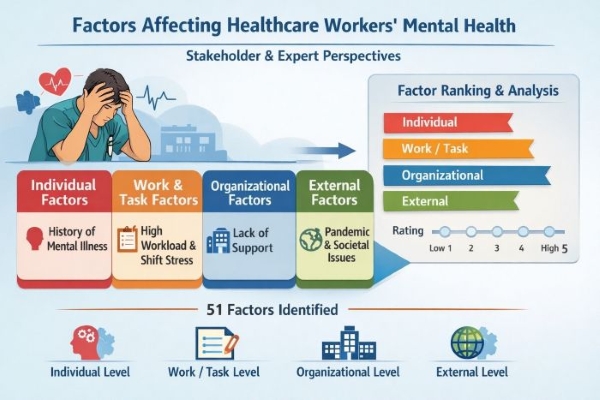
Results: 12 occupational health managers were interviewed, and 18 experts completed the ranking. 51 factors across 19 subcategories were identified in four main work-system levels: Individual (14 factors), Work/Task (16), Organizational (12), and External (9). In ranking, a history of mental illness was rated as the most important factor (mean 4.36), while working with automation was rated as the least important (mean 2.84); 11 factors scored >4, and many factors scored 3.5–4.
Conclusion: Using a systemic approach and stakeholder input, this study identified and prioritized factors affecting healthcare workers’ mental health across four levels—individual, work/task, organizational, and external—enabling more targeted, evidence-based interventions.
Material and Methods: This qualitative-ranking study used semi-structured interviews with purposively sampled hospital occupational health managers to identify factors affecting healthcare workers’ mental health, with interviews recorded, transcribed, and analyzed using content analysis in MAXQDA until saturation. The identified factors were then rated by industrial psychology experts and psychiatrists using a five-point Likert survey.
Results: 12 occupational health managers were interviewed, and 18 experts completed the ranking. 51 factors across 19 subcategories were identified in four main work-system levels: Individual (14 factors), Work/Task (16), Organizational (12), and External (9). In ranking, a history of mental illness was rated as the most important factor (mean 4.36), while working with automation was rated as the least important (mean 2.84); 11 factors scored >4, and many factors scored 3.5–4.
Conclusion: Using a systemic approach and stakeholder input, this study identified and prioritized factors affecting healthcare workers’ mental health across four levels—individual, work/task, organizational, and external—enabling more targeted, evidence-based interventions.
Type of Study: Review |
Send email to the article author
| Rights and permissions | |
 |
This work is licensed under a Creative Commons Attribution-NonCommercial 4.0 International License. |