

Volume 16, Issue 1 (3-2026)
J Health Saf Work 2026, 16(1): 168-187 |
Back to browse issues page


Download citation:
BibTeX | RIS | EndNote | Medlars | ProCite | Reference Manager | RefWorks
Send citation to:


BibTeX | RIS | EndNote | Medlars | ProCite | Reference Manager | RefWorks
Send citation to:
Shafahi M, Mostafaee Dolatabad K, Najafi Juybari M, Omidi L. Prioritizing Factors Influencing Failure in the Crisis Management System of a Process Industry Using the Analytic Hierarchy Process. J Health Saf Work 2026; 16 (1) :168-187
URL: http://jhsw.tums.ac.ir/article-1-7310-en.html
URL: http://jhsw.tums.ac.ir/article-1-7310-en.html


1- Department of Occupational Health Engineering, School of Public Health, Tehran University of Medical Sciences, Tehran, Iran
2- Faculty of Management and Economics, Tarbiat Modares University, Tehran, Iran
3- Department of Industrial Engineering, Isfahan University of Technology, Isfahan, Iran
2- Faculty of Management and Economics, Tarbiat Modares University, Tehran, Iran
3- Department of Industrial Engineering, Isfahan University of Technology, Isfahan, Iran
Abstract: (77 Views)
Introduction: This study aimed to identify and prioritize factors leading to the failure of crisis management systems in a process industry. An integrated approach combining Fault Tree Analysis (FTA) and the Analytic Hierarchy Process (AHP) was employed.
Material and Methods: Initially, FTA was used to systematically identify factors contributing to the failure, resulting in a hierarchical model with one top event, four main intermediate events, 16 sub-intermediate events, and 42 basic events. Subsequently, the AHP method was applied to prioritize these identified factors based on pairwise comparisons conducted by a panel of 11 industry and academic experts.
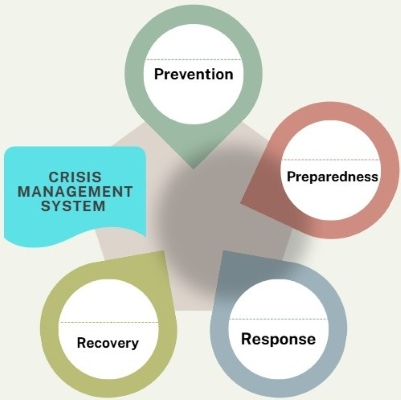
Results: The AHP results revealed that among the main phases of crisis management, failure in the prevention phase held the highest priority (weight = 0.380), followed by failure in the preparedness phase (0.280), response phase (0.245), and recovery phase (0.095). Key basic events identified included knowledge-skill gaps in leadership, inadequate periodic inspection programs, malfunctioning warning equipment, and untimely budget allocation.
Conclusion: The study findings confirm that prevention is the most pivotal phase in crisis management within process industries. By utilizing the integrated FTA-AHP framework, managers can systematically prioritize failure factors and align corrective actions with the most influential determinants, thereby enabling targeted resource allocation and strategic reinforcement of the crisis management system.
Material and Methods: Initially, FTA was used to systematically identify factors contributing to the failure, resulting in a hierarchical model with one top event, four main intermediate events, 16 sub-intermediate events, and 42 basic events. Subsequently, the AHP method was applied to prioritize these identified factors based on pairwise comparisons conducted by a panel of 11 industry and academic experts.
Results: The AHP results revealed that among the main phases of crisis management, failure in the prevention phase held the highest priority (weight = 0.380), followed by failure in the preparedness phase (0.280), response phase (0.245), and recovery phase (0.095). Key basic events identified included knowledge-skill gaps in leadership, inadequate periodic inspection programs, malfunctioning warning equipment, and untimely budget allocation.
Conclusion: The study findings confirm that prevention is the most pivotal phase in crisis management within process industries. By utilizing the integrated FTA-AHP framework, managers can systematically prioritize failure factors and align corrective actions with the most influential determinants, thereby enabling targeted resource allocation and strategic reinforcement of the crisis management system.
Keywords: Crisis management, Process industry, Fault tree analysis, Analytic hierarchy process, Prioritization
Type of Study: Review |
| Rights and permissions | |
 |
This work is licensed under a Creative Commons Attribution-NonCommercial 4.0 International License. |