

Volume 16, Issue 1 (3-2026)
J Health Saf Work 2026, 16(1): 188-212 |
Back to browse issues page



Download citation:
BibTeX | RIS | EndNote | Medlars | ProCite | Reference Manager | RefWorks
Send citation to:


BibTeX | RIS | EndNote | Medlars | ProCite | Reference Manager | RefWorks
Send citation to:
Pajoohnia M, Ghasemi F, Mahmoudi Herris S, Omidi L. Application of the Human Factors Analysis and Classification System (HFACS) in Accident Analysis and Safety Recommendation Prioritization: A Multi-Criteria Decision-Making Approach. J Health Saf Work 2026; 16 (1) :188-212
URL: http://jhsw.tums.ac.ir/article-1-7311-en.html
URL: http://jhsw.tums.ac.ir/article-1-7311-en.html


1- Department of Occupational Health Engineering, School of Public Health, Tehran University of Medical Sciences, Tehran, Iran
2- Department of Occupational Health and Safety Engineering, Abadan University of Medical Sciences, Abadan, Iran
3- Department of Health, Safety, and Environment (HSE), MAPNA Group, Tehran, Iran
2- Department of Occupational Health and Safety Engineering, Abadan University of Medical Sciences, Abadan, Iran
3- Department of Health, Safety, and Environment (HSE), MAPNA Group, Tehran, Iran
Abstract: (71 Views)
Introduction: The present study was conducted with the objectives of identifying the human and organizational factors contributing to a drum fall accident, classifying these contributing factors based on the Human Factors Analysis and Classification System (HFACS) framework, and prioritizing safety recommendations using Multi-Criteria Decision-Making (MCDM) techniques.
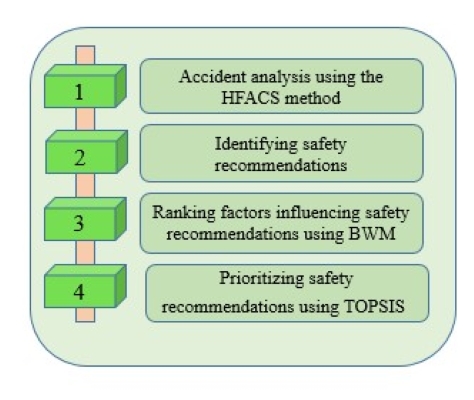
Material and Methods: The HFACS technique was initially applied across its four levels to determine the human and organizational factors involved in the HP drum fall accident from a rotator within a manufacturing industry. Subsequently, the proposed safety recommendations were prioritized using the Best-Worst Method (BWM) and Technique for Order Preference by Similarity to Ideal Solution (TOPSIS), based on four criteria: effectiveness, initial cost, reliability, and maintainability.
Results: The contributing factors identified in this study included inattention to the longitudinal movement of the drum during rotation on the rotator, as well as non-compliance with the rotator’s loading capacity relative to its mechanical strength and associated equipment (HFACS Level 1); failure to conduct a design risk assessment to identify critical points related to structural balance and stability (HFACS Level 2); non-adherence to the manufacturing sequence (HFACS Level 3); and the omission of a mechanical locking system for the rotator on the rail and failure to use certified rotating equipment with specified capacities (HFACS Level 4). The three safety recommendations identified with the highest priority were “using certified rotating equipment with specified capacity limits (relative closeness coefficient = 0.822)”, “adhering to the standard drum fabrication sequence (0.749)”, and “the on-site presence of a supervisor or foreman (0.698)”.
Conclusion: The ultimate objective of safety management systems is to propose corrective safety measures based on findings from accident analysis. Implementing safety recommendations as a structured framework not only prevents accident occurrence but also establishes protective layers that mitigate the recurrence of similar accidents in the future.
Material and Methods: The HFACS technique was initially applied across its four levels to determine the human and organizational factors involved in the HP drum fall accident from a rotator within a manufacturing industry. Subsequently, the proposed safety recommendations were prioritized using the Best-Worst Method (BWM) and Technique for Order Preference by Similarity to Ideal Solution (TOPSIS), based on four criteria: effectiveness, initial cost, reliability, and maintainability.
Results: The contributing factors identified in this study included inattention to the longitudinal movement of the drum during rotation on the rotator, as well as non-compliance with the rotator’s loading capacity relative to its mechanical strength and associated equipment (HFACS Level 1); failure to conduct a design risk assessment to identify critical points related to structural balance and stability (HFACS Level 2); non-adherence to the manufacturing sequence (HFACS Level 3); and the omission of a mechanical locking system for the rotator on the rail and failure to use certified rotating equipment with specified capacities (HFACS Level 4). The three safety recommendations identified with the highest priority were “using certified rotating equipment with specified capacity limits (relative closeness coefficient = 0.822)”, “adhering to the standard drum fabrication sequence (0.749)”, and “the on-site presence of a supervisor or foreman (0.698)”.
Conclusion: The ultimate objective of safety management systems is to propose corrective safety measures based on findings from accident analysis. Implementing safety recommendations as a structured framework not only prevents accident occurrence but also establishes protective layers that mitigate the recurrence of similar accidents in the future.
Keywords: Accident, Human Factors Analysis and Classification System (HFACS), Safety recommendations, Organizational factors
Type of Study: Review |
| Rights and permissions | |
 |
This work is licensed under a Creative Commons Attribution-NonCommercial 4.0 International License. |