

Volume 15, Issue 4 (12-2025)
J Health Saf Work 2025, 15(4): 747-760 |
Back to browse issues page



Download citation:
BibTeX | RIS | EndNote | Medlars | ProCite | Reference Manager | RefWorks
Send citation to:


BibTeX | RIS | EndNote | Medlars | ProCite | Reference Manager | RefWorks
Send citation to:
Keyvani S, Golbabaei F, Esmaeely Neisiany R, Kalantary S, Das O, Rahimi Foroushani A. Evaluating Morphological Characteristics and Filtration Performance of Electrospun Poly(Vinyl Alcohol)-Based Nanofiber Membranes for Capturing Particulate Matter. J Health Saf Work 2025; 15 (4) :747-760
URL: http://jhsw.tums.ac.ir/article-1-7254-en.html
URL: http://jhsw.tums.ac.ir/article-1-7254-en.html
Sepideh Keyvani1 
 , Farideh Golbabaei *2 , Rasoul Esmaeely Neisiany3 , Saba Kalantary1 , Oisik Das4 , Abbas Rahimi Foroushani5
, Farideh Golbabaei *2 , Rasoul Esmaeely Neisiany3 , Saba Kalantary1 , Oisik Das4 , Abbas Rahimi Foroushani5
1- Department of Occupational Health, School of Public Health, Tehran University of Medical Sciences, Tehran, Iran
2- Department of Occupational Health, School of Public Health, Tehran University of Medical Sciences, Tehran, Iran ,fgolbabaei@yahoo.com
3- Department of Polymer Engineering, Hakim Sabzevari University, Sabzevar, Iran | Department of Biotechnology Centre, Silesian University of Technology, Gliwice, Poland
4- Department of Civil, Environmental and Natural Resources Engineering, Luleå University of Technology, Luleå, Sweden
5- Department of Epidemiology and Biostatistics, School of Public Health, Tehran University of Medical Sciences, Tehran, Iran
2- Department of Occupational Health, School of Public Health, Tehran University of Medical Sciences, Tehran, Iran ,
3- Department of Polymer Engineering, Hakim Sabzevari University, Sabzevar, Iran | Department of Biotechnology Centre, Silesian University of Technology, Gliwice, Poland
4- Department of Civil, Environmental and Natural Resources Engineering, Luleå University of Technology, Luleå, Sweden
5- Department of Epidemiology and Biostatistics, School of Public Health, Tehran University of Medical Sciences, Tehran, Iran
Abstract: (888 Views)
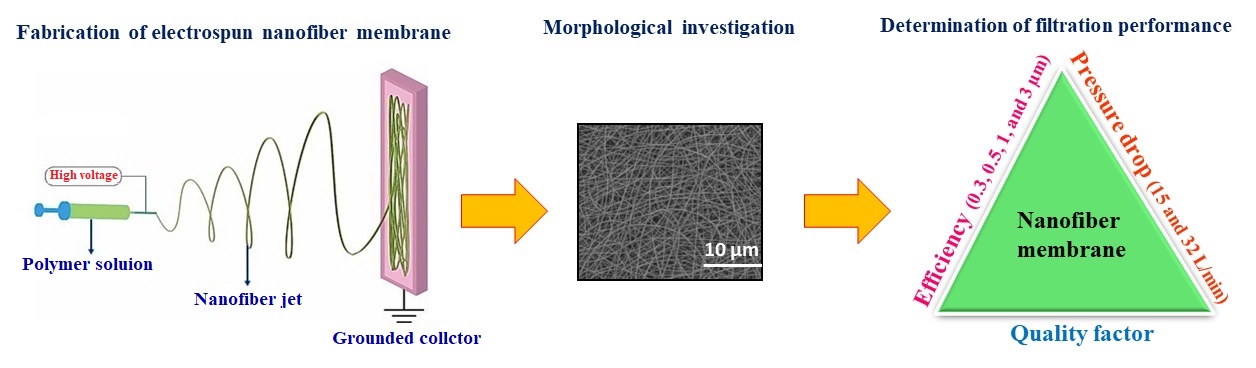
Introduction: Polymer nanofiber filters have great potential for controlling particulate pollution due to their high filtration efficiency and low pressure drop. This study aimed to fabricate nanofiber membranes from a biodegradable polymer through solution electrospinning to address both health and environmental concerns, along with analyzing their morphological characteristics. The filtration performance of the prepared membranes was evaluated against different particle sizes under two air face velocities.
Material and Methods: The nanofiber membranes were fabricated from aqueous poly(vinyl alcohol) (PVA) solutions at various concentrations from 5 to 6 w/v% under different process parameters. The morphological characteristics of the nanofibers were examined using field-emission scanning electron microscopy (FE-SEM), while structural properties such as basis weight and thickness were measured to estimate porosity. Filtration performance, including efficiency and pressure drop, was evaluated at two standard air face velocities (2.5 and 5.3 cm/s) using a media test system. In addition, the quality factor of the prepared membranes was calculated.
Results: The electrospun nanofibers were uniform and bead-free, with the mean fiber diameters ranging from 106 to 151 nm. The filtration efficiencies were 95.72–99.92 % for sub-micron particles (0.3 and 0.5 µm), and 99.43–100 % for larger particles (1 and 3 µm). The pressure drop ranged from 67 to150 Pa at an air face velocity of 2.5 cm/s, and from 58 to150 Pa at an air face velocity of 5.3 cm/s.
Conclusion: The 6 wt.% PVA nanofiber membrane electrospun at 15 kV, 0.5 mL/h, and 15 cm produced thinner fibers (approximately 106 nm) and exhibited higher efficiency for 0.3 µm particles (99.89 % and 99.92 % at 2.5 and 5.3 cm/s air face velocities, respectively). For this membrane with thinner fibers, the pressure drop increased from 67 to 150 Pa with rising the air face velocity.
Material and Methods: The nanofiber membranes were fabricated from aqueous poly(vinyl alcohol) (PVA) solutions at various concentrations from 5 to 6 w/v% under different process parameters. The morphological characteristics of the nanofibers were examined using field-emission scanning electron microscopy (FE-SEM), while structural properties such as basis weight and thickness were measured to estimate porosity. Filtration performance, including efficiency and pressure drop, was evaluated at two standard air face velocities (2.5 and 5.3 cm/s) using a media test system. In addition, the quality factor of the prepared membranes was calculated.
Results: The electrospun nanofibers were uniform and bead-free, with the mean fiber diameters ranging from 106 to 151 nm. The filtration efficiencies were 95.72–99.92 % for sub-micron particles (0.3 and 0.5 µm), and 99.43–100 % for larger particles (1 and 3 µm). The pressure drop ranged from 67 to150 Pa at an air face velocity of 2.5 cm/s, and from 58 to150 Pa at an air face velocity of 5.3 cm/s.
Conclusion: The 6 wt.% PVA nanofiber membrane electrospun at 15 kV, 0.5 mL/h, and 15 cm produced thinner fibers (approximately 106 nm) and exhibited higher efficiency for 0.3 µm particles (99.89 % and 99.92 % at 2.5 and 5.3 cm/s air face velocities, respectively). For this membrane with thinner fibers, the pressure drop increased from 67 to 150 Pa with rising the air face velocity.
Type of Study: Research |
Send email to the article author
| Rights and permissions | |
 |
This work is licensed under a Creative Commons Attribution-NonCommercial 4.0 International License. |