

Volume 15, Issue 4 (12-2025)
J Health Saf Work 2025, 15(4): 823-841 |
Back to browse issues page



Download citation:
BibTeX | RIS | EndNote | Medlars | ProCite | Reference Manager | RefWorks
Send citation to:


BibTeX | RIS | EndNote | Medlars | ProCite | Reference Manager | RefWorks
Send citation to:
Safari N, Kazemian Talekhooncheh A, Jafarzadeh Kohneloo A, Ahmadi S, Moradi G. Effect of Sound Absorber Design and Installation on Reverberation Time and Speech Quality in a Dental Clinic. J Health Saf Work 2025; 15 (4) :823-841
URL: http://jhsw.tums.ac.ir/article-1-7258-en.html
URL: http://jhsw.tums.ac.ir/article-1-7258-en.html
Nazanin Safari1 
 , Alireza Kazemian Talekhooncheh2 , Arefeh Jafarzadeh Kohneloo3 , Saeed Ahmadi4 , Gholamreza Moradi *5
, Alireza Kazemian Talekhooncheh2 , Arefeh Jafarzadeh Kohneloo3 , Saeed Ahmadi4 , Gholamreza Moradi *5
1- Department of Occupational Health, School of Public Health, Tabriz University of Medical Sciences, Tabriz, Iran
2- Department of Safety Engineering, Science and Arts University, Yazd, Iran
3- Department of Statistics and Epidemiology, Faculty of Health, Tabriz University of Medical Sciences, Tabriz, Iran
4- Department of Occupational Health Engineering, School of Public Health, Qazvin University of Medical Sciences, Qazvin, Iran
5- Department of Occupational Health, School of Public Health, Tabriz University of Medical Sciences, Tabriz, Iran ,moradig@tbzmed.ac.ir
2- Department of Safety Engineering, Science and Arts University, Yazd, Iran
3- Department of Statistics and Epidemiology, Faculty of Health, Tabriz University of Medical Sciences, Tabriz, Iran
4- Department of Occupational Health Engineering, School of Public Health, Qazvin University of Medical Sciences, Qazvin, Iran
5- Department of Occupational Health, School of Public Health, Tabriz University of Medical Sciences, Tabriz, Iran ,
Abstract: (677 Views)
Introduction: Exposure to noise is one of the most common harmful factors in the dental profession that can have significant consequences. Unfavorable acoustic conditions of the environment can also worsen the conditions and lead to reduced speech clarity, auditory fatigue, and reduced quality of communication between the doctor and the patient. In this regard, designing effective acoustic interventions can play an important role in improving sound.
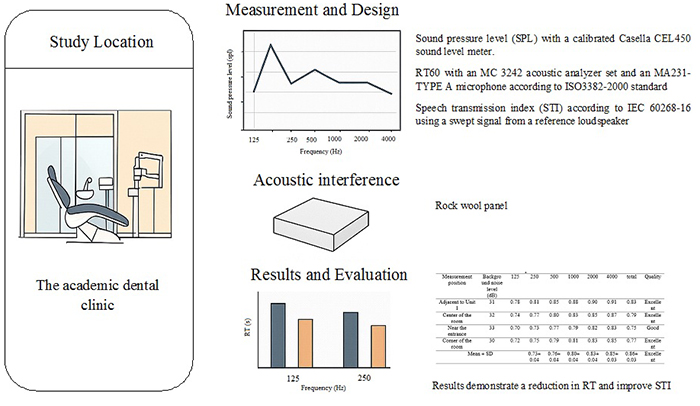
Material and Methods: This study was conducted in an academic dental clinic. After measuring the sound pressure level, reverberation time, and speech transmission index, the amount of rock wool absorber required was determined using the Sabin formula. The panels were structurally installed on the clinic walls, and after 24 hours, the sound pressure level, RT60, and STI were measured again, and appropriate statistical tests were used to determine the effect of the intervention.
Results: The results showed that the sound pressure level before and after the panel installation was significantly different and decreased after the intervention (p-value <0.05). The reverberation time at the dominant frequency of 2000 was 0.992 seconds before the intervention and reached 0.599 seconds after the intervention (p=0.027, z= 2.207). The speech transmission index in the center of the room improved from 0.64 and the “average” level to 0.85 and the “excellent” level, indicating an increase in speech clarity.
Conclusion: The acoustic intervention was able to bring the clinic’s acoustic indices closer to the recommended ranges. The significant reduction in reverberation time and sound pressure level along with the increase in the speech clarity index indicates the high efficiency of this intervention. Utilizing sound absorbers can be a low-cost and feasible solution to improve acoustic conditions and improve speech communication in dental treatment and educational environments.
Material and Methods: This study was conducted in an academic dental clinic. After measuring the sound pressure level, reverberation time, and speech transmission index, the amount of rock wool absorber required was determined using the Sabin formula. The panels were structurally installed on the clinic walls, and after 24 hours, the sound pressure level, RT60, and STI were measured again, and appropriate statistical tests were used to determine the effect of the intervention.
Results: The results showed that the sound pressure level before and after the panel installation was significantly different and decreased after the intervention (p-value <0.05). The reverberation time at the dominant frequency of 2000 was 0.992 seconds before the intervention and reached 0.599 seconds after the intervention (p=0.027, z= 2.207). The speech transmission index in the center of the room improved from 0.64 and the “average” level to 0.85 and the “excellent” level, indicating an increase in speech clarity.
Conclusion: The acoustic intervention was able to bring the clinic’s acoustic indices closer to the recommended ranges. The significant reduction in reverberation time and sound pressure level along with the increase in the speech clarity index indicates the high efficiency of this intervention. Utilizing sound absorbers can be a low-cost and feasible solution to improve acoustic conditions and improve speech communication in dental treatment and educational environments.
Type of Study: Research |
Send email to the article author
| Rights and permissions | |
 |
This work is licensed under a Creative Commons Attribution-NonCommercial 4.0 International License. |